Queueing outside a comic shop before it even opens, for books that will not cost a cent, feels like an odd kind of commitment if you have never set foot inside one before. The worry is less about money and more about looking lost: not knowing which stack to join, which title to keep, or whether the person behind the counter will size you up as a tourist passing through. For newcomers, this is often the exact unease that Free Comic Book Day arrives wrapped in, somewhere between curiosity and the fear of getting it wrong on a first real visit to a specialist shop. The good news is that the day was built for precisely this moment, and a little preparation turns the uncertainty into one of the easier ways to start a collection.
Free Comic Book Day is an annual event that brings participating comic shops around the world together on a single Saturday to hand out specially printed issues at no cost. It began in the United States in 2002 and has since grown into a fixture of the collecting calendar. What follows is a practical look at how Free Comic Book Day in Singapore works at shop level, what deserves your attention on the day, and how one free comic can turn into the start of a proper collection.
What Free Comic Book Day Actually Is
Free Comic Book Day was proposed by the retailer Joe Field in 2001 and first held on the first Saturday of May the following year, deliberately scheduled to ride the publicity of a major Spider-Man film release. More than two decades on, the format has barely changed. Publishers subsidise the cost of specially printed issues, participating shops order them at a steep discount, and a selection committee of retailers, publishers and comics journalists decides which titles make the cut each year. Some books are free to every shop that signs up, while others are optional extras that a shop can choose to stock depending on demand and shelf space.
Why Singapore Collectors Should Treat It as More Than a Freebie Day
It is tempting to treat Free Comic Book Day as a once-a-year novelty, something to mention to a curious friend instead of a serious collecting moment. That undersells it. For a shop built around specialist depth instead of breadth, the day is one of the only times a complete beginner can walk in, take something home, and decide whether the hobby suits them without spending a single dollar.
The event also tends to coincide with new printings and reissues timed around whichever Marvel film or series is drawing attention that year, which means the free titles on offer are rarely random filler. Shops frequently use the day to showcase runs that tie into a current release, giving newcomers an easy entry point into a character they already recognise from the screen. For collectors who already have a shelf of back issues, it is also a low-pressure chance to browse without the usual budget creep that comes with chasing a specific key issue. There is no fee at the door and no obligation to buy anything else, which removes a good deal of the social pressure that keeps newcomers away from specialist shops in the first place. In a hobby where jargon and unfamiliar etiquette can be genuinely intimidating, that absence of pressure does more for a newcomer than the free books themselves.
None of this means the day is without its own quirks, though. Supply is limited, popular titles run out quickly, and a shop’s opening hours on the day are usually earlier than normal, so a little planning goes a long way.
How to Prepare Before You Queue
A bit of groundwork before the day removes most of the guesswork. None of it requires deep comics knowledge, just the same preparation you would bring to any popular one-day sale.
- Check the participating shop’s exact opening time for the day, since many open earlier than their usual hours and some titles disappear within the first hour.
- Look up the year’s full title list in advance so you are choosing based on characters or stories you actually want, instead of grabbing at random once you are at the counter.
- Bring a tote bag or similar carrier. A handful of single issues without covers is an easy way to end up with bent corners before you even get them home.
- Set a personal limit on how many titles to take if a shop caps selections per customer, which is common when supply is tight.
- Have a short want list ready. If a title runs out, staff can often note down what you were after for the regular mailing list or a future restock.
What to Expect on the Day
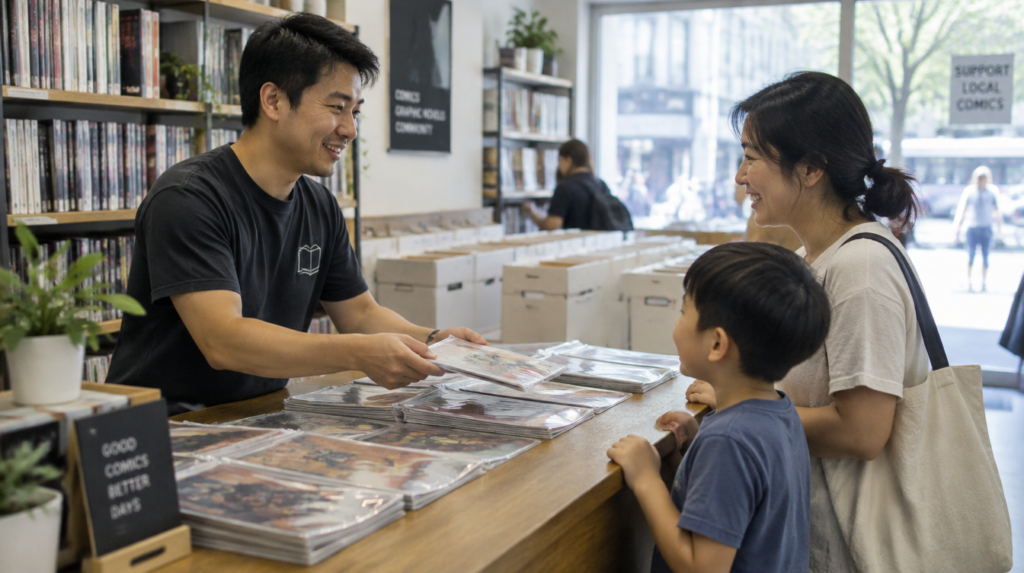
Expect a noticeably different atmosphere from an ordinary Wednesday restock. Shops often extend the day into a small event of its own, with tables of discounted back issues, a chance to meet other collectors, and sometimes a cosplay presence or a sketch table if a local artist is in. Staff tend to be more generous with their time than during a typical New Comic Book Day rush, since part of the point of the event is making newcomers feel welcome instead of processing a queue as fast as possible. This is a good moment to ask the questions you have been too self-conscious to ask on a normal visit.
At a shop with a genuine specialist focus, do not expect every publisher under the sun. The free titles and any accompanying promotions tend to stay close to what the shop already does well, which at a Marvel-focused store means Marvel-adjacent titles instead of a broad sampler of the entire industry.
Spotting the Variants and Promotional Editions Worth Keeping
Not every Free Comic Book Day issue ages the same way. Most are simply a nice freebie that introduces a character or storyline, read once and shelved. A smaller number turn out to matter more than anyone expected at the time, usually because of a first appearance buried inside an otherwise ordinary giveaway.
Some retailers also arrange store-exclusive variant covers for the day, printed in small numbers and never sold anywhere else, which is part of why a handful of past editions now carry real value on the secondary market. A look back at past Free Comic Book Day editions found a 2011 Star Wars: The Clone Wars giveaway featuring the first appearance of a minor character peaking near five hundred dollars for a high-grade CGC-graded comics copy, and a 2022 Avengers and X-Men crossover variant trending upward on the back of a first appearance tied to a popular bloodline. None of this means every free comic is a hidden investment, and treating it that way misses the point of the day entirely. A first printing with a genuine first appearance deserves a protective sleeve and board instead of a spot loose in a stack of handouts, while everything else is simply a free comic to enjoy. If in doubt, a shop that deals in CGC-graded comics day to day can usually tell you on the spot whether a particular issue is one to set aside.
The safest approach for a beginner is simple. Keep anything that looks like a true first appearance or a store-exclusive cover in good condition, and let everything else be exactly what it was meant to be.
Turning a Free Comic Into a Lasting Collecting Habit
For a lot of collectors, Free Comic Book Day is where the hobby actually starts, more than a one-off visit. Taking home a free issue of a character you liked on screen is a natural lead into asking a shop what else that character has appeared in, which is a much easier opening line than walking in cold and announcing you want to start collecting. From there, joining a shop’s mailing list for weekly new-arrival alerts costs nothing and keeps the following New Comic Book Day on your radar instead of another once-a-year surprise.
If a particular free issue leaves you wanting the rest of a run, a want list is the practical next step instead of hunting shelf by shelf on your own. Most specialist shops will take on sourcing requests for specific issues and come back with a firm quote once they have tracked a copy down, which keeps the cost predictable instead of open-ended. It turns a single free comic into an actual reading plan, built one confirmed issue at a time, much like the groundwork laid out in your Marvel comic collection journey.
Common Beginner Mistakes on Free Comic Book Day
A handful of avoidable mistakes account for most of the disappointment collectors report after their first Free Comic Book Day. None of them are complicated to fix once you know to look out for them.
- Arriving at the shop’s usual opening time instead of checking the day’s earlier schedule, and missing the busiest and best-stocked window entirely.
- Grabbing one of every title on offer without reading the list first, then ending up with several comics that hold no real interest once the excitement wears off.
- Leaving single issues loose in a bag for the rest of the day, which is how spine ticks and reading creases start before a comic has even made it home.
- Assuming every free comic is automatically valuable, then feeling let down when a shop politely explains that most are not.
Frequently Asked Questions
When is Free Comic Book Day held?
It falls on the first Saturday of May in most years, though the exact date is occasionally shifted by the organisers, so checking a participating shop’s own announcement each year is safer than assuming the date automatically.
Do I need to buy anything else to get the free comics?
No. Participating shops hand out the day’s titles with no purchase necessary, though many extend small in-store discounts on the same day for anyone who wants to browse further.
Can I get Free Comic Book Day titles later in the year if I miss the day itself?
Usually not through the free promotion itself, since shops order a limited quantity for the day and do not typically restock it afterwards. Some titles do turn up later on the secondary market, generally at a price well above face value once supply runs out.
Are Free Comic Book Day issues suitable for kids?
Many of the selected titles are chosen with a general audience in mind, including all-ages stories, though content varies by publisher and title. Checking the age guidance printed on the cover, or simply asking staff on the day, is the most reliable way to judge whether a particular issue suits a younger reader.
Should I get a Free Comic Book Day issue professionally graded?
Only in the rare case where the issue carries a genuine first appearance or a numbered store-exclusive cover, and even then it comes down to personal preference instead of a guaranteed return. For everyday giveaway titles, a protective sleeve and board are a more sensible use of the budget than a grading submission.
However the day goes for you, the real value lies less in what you walk away with than in whether it gets you through a specialist shop’s door more than once a year. If a free issue leaves you curious about what else is out there, we are always glad to help a newcomer work out where to start, so feel free to get in touch and we will take it from there.